Most Morocco eSIM guides tell you the country has “good 4G coverage.” That’s true and useless. Morocco has good coverage in the imperial cities and patchy or nonexistent coverage across much of what you’re actually going there for: the desert, the Atlas gorges, the mountain roads.
This article is organised like the real trip, not like a manual. The route most travellers take — Marrakech, Atlas, desert, back via Fez or Chefchaouen — and what signal you’ll have on each leg.
The three carriers and why it matters which one you get
Morocco has three networks: Maroc Telecom (IAM), Orange Maroc and Inwi.
They’re not interchangeable. Maroc Telecom is the former state operator and has the inherited infrastructure: towers in small villages, coverage on southern national roads, presence in rural Atlas areas where the other two never invested. Orange and Inwi are younger competitors that concentrated their rollout on the major cities and the Casablanca–Rabat–Tangier corridor.
Translated to your trip: in Marrakech, Fez or Casablanca all three work equally well. In Merzouga, the Dades Valley or on the Tizi n’Tichka road, Maroc Telecom is the one that saves you.
An international eSIM automatically routes through the strongest available network, so you don’t choose manually — but knowing this explains why you’ll have signal on some legs and not others, and why your travel companion on a different eSIM might have bars when you don’t.
Leg 1 — Marrakech and surroundings
Coverage: excellent. 4G/5G across the whole city.
The medina, Jemaa el-Fna, Gueliz, the riads in the old town — full signal, and 5G in the modern parts of the city.
Two practical warnings:
Inside the medina, GPS goes haywire. This isn’t a data coverage problem, it’s a positioning one: narrow alleys with high walls degrade the GPS signal and Google Maps places you a street away from where you actually are. Active data improves this via network triangulation, but doesn’t fully fix it. Download the offline map of Marrakech anyway.
Riads have WiFi, but it’s bad. The Marrakech medina has limited fibre infrastructure and many riads share one slow connection across all their rooms. Mobile data usually outperforms your accommodation’s WiFi.
Estimated consumption in Marrakech: 300–500 MB per day with normal use. Continuous maps, WhatsApp, photos, the occasional restaurant search.
Leg 2 — The Atlas road (Tizi n’Tichka)
Coverage: intermittent, with long dropouts.
The N9 crossing the High Atlas from Marrakech towards Ouarzazate climbs to the 2,260-metre Tizi n’Tichka pass. It’s one of the most spectacular roads in the country and one of the worst for coverage.
There’s signal in the villages where everyone stops — Taddert, Ighrem — and completely dead stretches on the mountain switchbacks between them. If you’re driving a hire car and relying on Maps to know where to turn off for Aït Ben Haddou, the offline map isn’t optional.
What works: grand taxis and organised transfers know the route and don’t need GPS. If you’re with a driver, the coverage gap is irrelevant except for your stories.
What fails: if you’re driving yourself and didn’t download the section, you’re facing a long stretch of uncertainty on a mountain pass with tight bends and lorries. Download it.
Leg 3 — Ouarzazate, Aït Ben Haddou and the Dades Valley
Coverage: good in towns, patchy between them.
Ouarzazate has solid 4G — it’s a mid-sized city with film studios and constant tourist flow. Aït Ben Haddou, the earthen ksar that appears in every desert-set film, has coverage in the new village and weak signal inside the old ksar.
The Dades Valley and the Todra Gorges are another story. There’s signal in Boumalne Dades and Tinghir, the two main towns, but the roads climbing through the gorges have long stretches with nothing. In the Todra Gorges themselves — the 300-metre-walled canyon — there’s no coverage, and that’s normal: there never will be.
Estimated consumption on this leg: low, 200–300 MB/day. You’re outdoors most of the time and there isn’t much to do with your phone.
Leg 4 — Merzouga and the desert (Erg Chebbi)
Coverage: surprisingly good in the village, none in the dunes.
Merzouga has 4G. That’s the fact that surprises people most. The village lives off desert tourism and the carriers have deployed there because there’s constant year-round demand.
What has no coverage are the dunes. As soon as you head into Erg Chebbi by camel or 4x4 towards camp, the signal disappears soon after you leave the village. Tented camps closest to the village sometimes catch a weak signal; the ones genuinely inside the erg don’t.
This is a feature, not a problem. You’re going to the desert precisely for this. But it’s worth knowing beforehand: tell people at home you’ll be offline for a night, and don’t count on posting the sunrise over the dunes live. Post it when you’re back.
One logistical detail: if you booked the camp over WhatsApp with a local operator — which is how most desert bookings work in Morocco — confirm the meeting point before leaving Merzouga. Without coverage you won’t be able to message them if something goes wrong.
Leg 5 — Fez
Coverage: excellent in the city, poor inside the medina.
Fez has one of the largest and most labyrinthine medinas in the world: thousands of alleyways with no consistent naming. Data coverage is good across the city, but inside the medina the same thing happens as in Marrakech, multiplied — high walls and covered alleys degrade GPS to the point of near-uselessness.
Here mobile data genuinely matters, because network-based position correction is the only thing preventing Maps from placing you streets away from where you are. With an active eSIM and a downloaded offline map, you’ll manage. Without either, you get lost — and in the Fez medina getting lost isn’t a metaphor.
Leg 6 — Chefchaouen and the north
Coverage: good. Stable 4G.
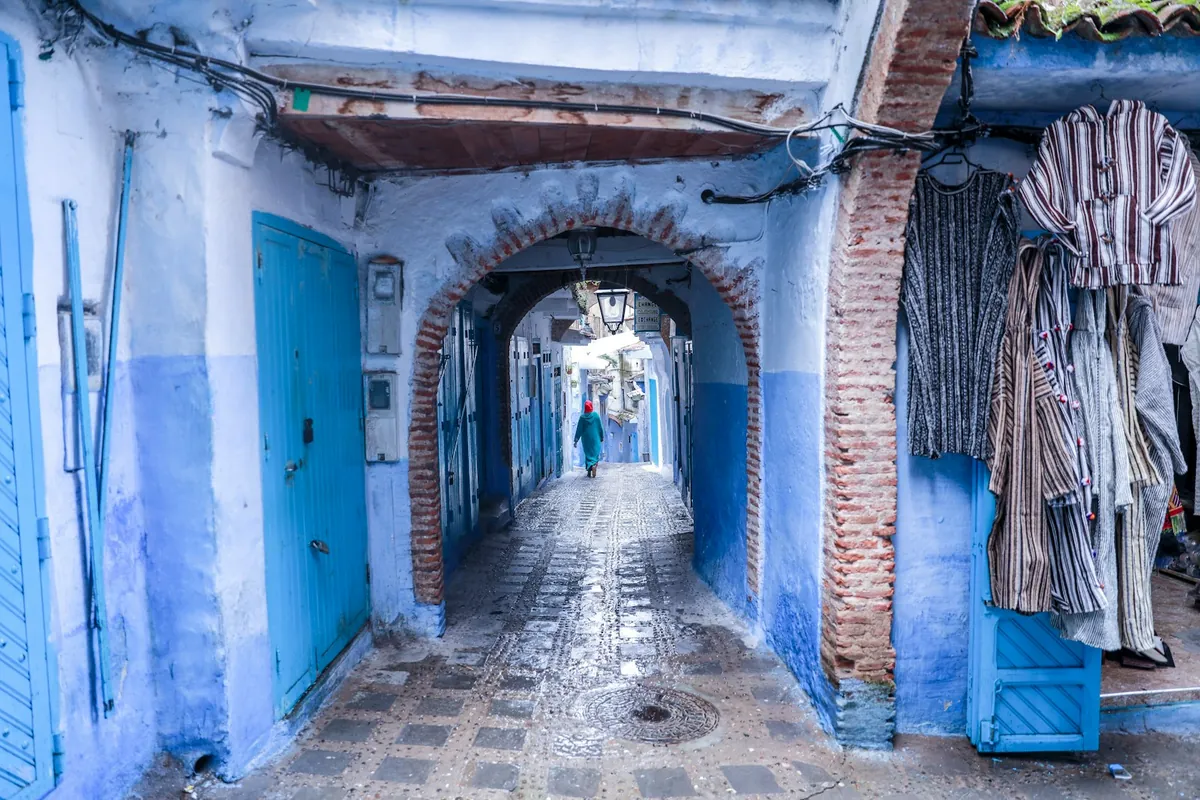
Chefchaouen is well covered. The blue town is small, touristy and all three carriers have presence. The walk up to the Spanish Mosque for sunset has signal. Hiking routes into the Rif that start from town lose it above a certain altitude, but for the standard visitor coverage isn’t an issue.
If you continue towards Tangier or Tetouan, the northern corridor has the best coverage in the country after Casablanca–Rabat.
How much data you need: the answer by route type
Classic 7–8 day route (Marrakech → Atlas → desert → back): 3–5 GB. Real consumption is lower than you’d expect, because there are entire legs without coverage where you spend nothing and desert nights completely offline.
Long 12–15 day route (adding Fez, Chefchaouen, the coast): 5–10 GB. More cities, more navigation, more searches.
With remote work, or travelling solo and relying on your phone for everything: 10GB or more. Morocco is a destination where accommodation WiFi is noticeably worse than average, and you’ll lean on data more than you think.
If you’re driving yourself: go up a tier. Offline maps handle navigation, but searches for petrol stations, last-minute accommodation and roadwork detours — and there are plenty — eat through data.
MolaHop Morocco prices
| Plan | Validity | Price |
|---|---|---|
| 1 GB | 7 days | €6.09 |
| 3 GB | 15 days | €11.29 |
| 3 GB | 30 days | €12.29 |
| 5 GB | 30 days | €14.99 |
| 10 GB | 30 days | €18.49 |
| 20 GB | 30 days | €28.29 |
| 50 GB | 30 days | €56.49 |
| Unlimited | per day | €5.09/day |
For the classic one-week route, 3GB is usually enough. For a longer route or if you’re driving, 10GB / 30 days.
Worth being transparent about one thing: Morocco is among the more expensive eSIM destinations, and not just with us: on 1 October 2026 every provider in the table below that sells GB plans charged more than twice as much for 5GB / 30 days in Morocco as in Thailand. Between providers, though, prices differ a lot — see the table, plan by plan.
One alternative is buying a local Moroccan SIM at the airport. It’s cheaper, but the process has friction worth knowing about beforehand: passport registration, high-season queues, prices that don’t match what’s advertised, and closed counters on night flights. We cover it in detail here: Buying a local SIM in Morocco: what nobody mentions
Want to see how much you save versus your carrier’s roaming? Work it out here: eSIM vs roaming calculator
👉 Get your Morocco eSIM from MolaHop
Price comparison for Morocco
| Plan | MolaHop | Airalo | Holafly | Nomad | SimLocal | Verified |
|---|---|---|---|---|---|---|
| 5 GB / 30 days | €14.99 live price | €20.00 source | Unlimited only source | €14.91 source | US$18.25 (≈ €16.15) source | |
| 10 GB / 30 days | €18.49 live price | €31.00 source | Unlimited only source | €18.42 source | US$30.25 (≈ €26.77) source | |
| 20 GB / 30 days | €28.29 live price | €39.00 source | Unlimited only source | €21.93 source | US$33.00 (≈ €29.21) source | |
| Unlimited / 7 days — SimLocal had no unlimited plan for Morocco. | €35.63 live price | €32.00 source | €28.90 source | €23.69 source | — source |
Competitor prices captured on 1 October 2026 from each brand's own website (the "source" link). MolaHop prices marked "live price" are current. SimLocal shows US dollars; the euro figure is our conversion at the ECB rate of 1 October 2026 (1 € = 1.1298 US$).
On 1 October 2026 MolaHop was the cheapest on 5GB (by one cent over Nomad) and on 10GB. On 20GB Nomad was cheaper, and on 7-day unlimited Nomad, Holafly and Airalo were all cheaper than us.
Five practical things before you fly
Download offline maps for these specific areas: Marrakech (including the medina), the Marrakech–Ouarzazate stretch on the N9, the Dades Valley, and the Fez medina if you’re going. These are the four points where you’ll lose coverage or reliable GPS.
Save the WhatsApp numbers of your accommodation and your desert operator before leaving a covered area. In Morocco almost everything is handled over WhatsApp.
EU roaming doesn’t apply. Morocco isn’t in the EU. Using your home SIM without an eSIM means high international roaming rates — same situation as Turkey or Albania.
Carry cash. Not a connectivity issue but related: outside the major cities, card and mobile payments are the minority. Data helps you find ATMs, not pay with them.
Activate the eSIM on landing, not before. Plans start counting from the first connection to a Moroccan network. Install it at home, activate it at the airport.
FAQ
Does Morocco have 5G? Yes, in the main cities, with progressive rollout. Elsewhere it’s 4G, which is sufficient for all travel use.
Does the eSIM work in the Merzouga desert? In Merzouga village, yes. In the dunes and the erg camps, no. This isn’t an eSIM problem: there’s no network deployed there.
What about the deep south (Dakhla, Laayoune)? There’s coverage in the main cities, mostly Maroc Telecom. Between cities there are very long stretches of road with nothing. If you’re doing the southern route, plan with offline maps and tell people your timings.
Can I use hotspot? Yes, on compatible devices.
Is the unlimited plan worth it? For Morocco, usually not. Unlimited is charged per day, and on 1 October 2026 a week of it cost more than the 20GB / 30-day plan. Unlimited only pays off for very short trips with very heavy use.
Does GPS work without data? Yes, GPS is independent of the mobile network. But accuracy improves significantly with data, especially in the medinas. With offline maps downloaded and GPS active you can navigate without coverage — slower and less precise, but it works.
Last updated: October 2026. MolaHop prices are live from molahop.com; competitor prices captured on 1 October 2026, with the source in each cell. Coverage cross-checked with Maroc Telecom, Orange Maroc and Inwi data, July 2026.