Short answer: Morocco is not part of EU roaming. Unless your operator includes Morocco in your plan, using your European SIM there without a roaming pass is charged at non-EU roaming rates, and data is where bills climb fastest. For mobile internet in Morocco you have three options: your operator’s roaming pass, a Moroccan SIM, or a travel eSIM.
And there’s a catch many travellers only find on their bill: you don’t have to cross the Strait to pay Moroccan roaming. In Tarifa, in Ceuta or on the ferry, your phone can connect to a Moroccan network, or to the ship’s own network, without you noticing.
What roaming in Morocco can cost
Morocco sits outside the EU’s “roam like at home” area. Each operator places it in its own zone, usually with daily or weekly passes. Without a pass, the per-MB price can be very high: Vodafone Spain charges €6.05 per MB, according to its website as cited by Selectra (21 October 2026).
The extreme case was reported by Xataka Móvil (September 2025): a French Orange customer forgot to turn off data in Morocco and came home to a €37,737 bill. Orange reduced it to €500, citing his good faith and his long history as a customer. It had first rejected his explanation, because it had sent him several usage warnings.
Before you travel, check which zone your operator puts Morocco in and what its pass costs. If you can’t find it, assume you’ll be charged.
The Strait of Gibraltar trap: Tarifa, Ceuta and the ferry
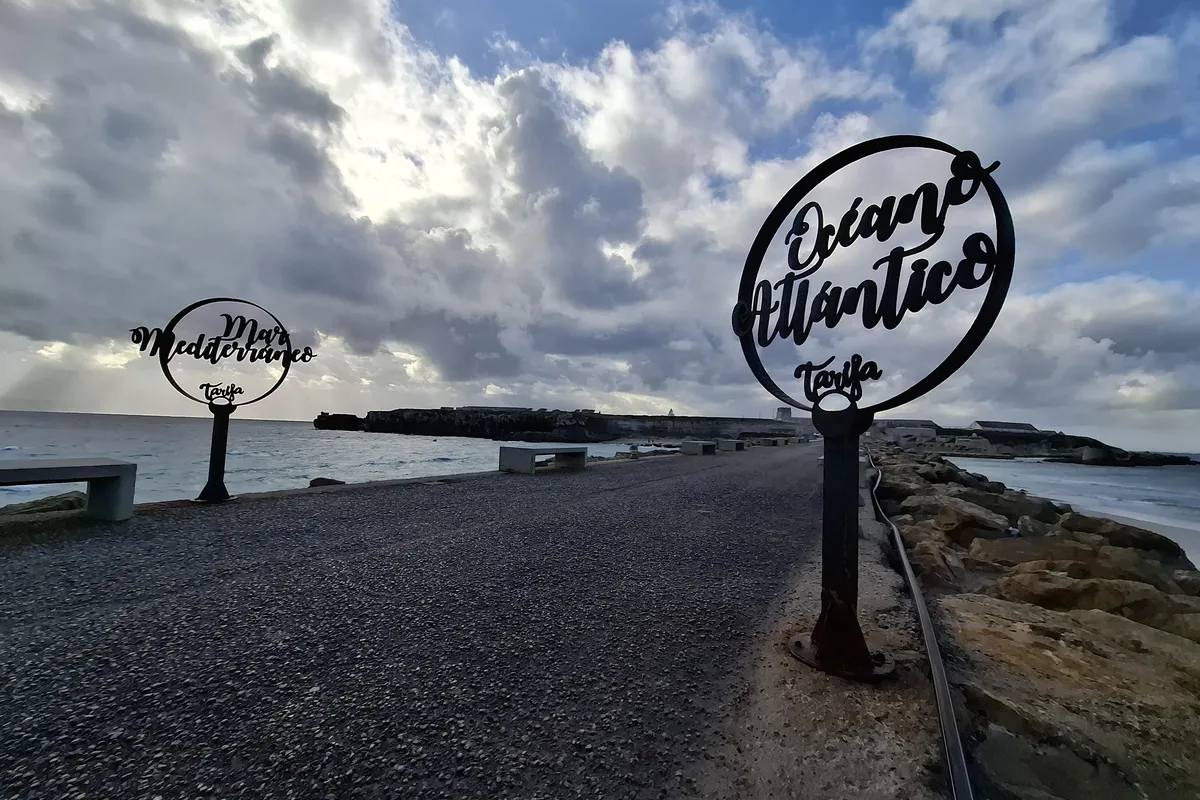
At its narrowest point, the Strait between Tarifa and Morocco is about 14 km wide. Your phone connects to the strongest signal, and near the Strait that mast can be on the other side.
- On Spain’s Cádiz coast, in Ceuta or in Melilla, your phone can latch onto a Moroccan network even though you’re still in Spain. Selectra describes it for the Strait, Ceuta and Melilla, and Alerta Digital (25 September 2026) for Ceuta.
- Users have reported it. Movistar’s customer forum has a thread titled “Mobile data charged as Moroccan roaming while in Tarifa” (in Spanish).
- And public complaints. In one from 2022, a Vodafone Spain customer reported to the consumer group OCU a €50 charge per line for a “connection to Morocco” on the day they were in La Línea de la Concepción. The customer then accepted a refund of those charges.
- On the ferry, your phone can connect to the ship’s own network. That maritime coverage isn’t included in your plan’s roaming: Selectra points this out for Vodafone on crossings to Ceuta, Melilla or Tangier.
What you can do:
- Turn off data roaming if you’re in the Strait area and not crossing. Your phone then can’t use data on a foreign network.
- Select your network manually in your phone’s settings instead of automatically. Near the border you may lose signal for a while; switch back to automatic when you leave the area.
- Watch the operator name on your screen and any “welcome to another country” text messages.
Under EU rules, Selectra explains, your operator must tell you how to avoid these connections in border areas and take reasonable steps against them, but it doesn’t have to guarantee they never happen. If you get a charge like this, complain to your operator first and keep the reference number.
Your three options for internet in Morocco
- Your operator’s roaming pass. Nothing to change, but the price depends on your operator and some passes are expensive for little data.
- A Moroccan SIM. Morocco has three operators: Maroc Telecom, Orange Maroc and inwi. SIMs are sold at airports, such as Casablanca’s, and in shops in town. You need your passport and an unlocked phone. At the airport it’s usually slightly more expensive than in town (Lonely Planet). It means swapping cards and using a Moroccan number.
- A travel eSIM, installed at home before you leave. Your home SIM stays in the phone for calls and texts, and your data runs on the eSIM at a fixed price, with no shop visit and no passport. See the plans on our Morocco page.
Coverage: cities, desert and mountains
According to Lonely Planet, almost all of the country has 4G and mobile coverage is surprisingly good even in remote areas; around the Sahara, Orange tends to work better. Wi-Fi is another matter: in desert camps it can come and go, and in the mountains it’s less reliable.
If you’re heading south, download offline maps before you leave the city.
Do WhatsApp calls work in Morocco?
Morocco blocked internet calls (WhatsApp, Skype, Viber) for most of 2016. The regulator, ANRT, told operators to restore them in November that year (Osiris, 4 November 2016). We’re not aware of a general block since then.
Before you fly
- Check your operator’s zone and pass price for Morocco.
- If you’re using a travel eSIM, install it at home, on Wi-Fi. If the QR code arrives on the same phone, install it without scanning anything.
- Turn off data roaming on your home line before you reach the Strait, not when you land: if you’re travelling through southern Spain, the risk starts in Tarifa, Ceuta or on the ferry.
When you land
- Select the travel eSIM as your data line.
- Turn on data roaming for that line. It’s the most common reason a travel eSIM “has no internet”. Full steps in why your eSIM has no internet even with roaming on.
- Keep your home line on for calls and texts only, if you want to stay reachable on your number.
FAQ
Is roaming free in Morocco? No. Morocco isn’t part of the EU roaming area. Unless your operator includes Morocco in your plan, it will charge non-EU roaming rates.
Can I be charged Moroccan roaming while still in Spain? Yes. Around the Strait of Gibraltar, in Ceuta or in Melilla, your phone can connect to a Moroccan network without you leaving Spain, and on the ferry to the ship’s network. Turn off data roaming or select your network manually.
Do EU roaming rules apply in Ceuta and Melilla? Ceuta and Melilla are part of Spain: on a Spanish network you use your normal plan. The problem starts when your phone connects to a nearby Moroccan mast.
What do I need to buy a SIM card in Morocco? Your passport and an unlocked phone. SIMs are sold at airports and in Maroc Telecom, Orange Maroc and inwi shops.
Is there mobile coverage in the Sahara? According to Lonely Planet, mobile coverage is surprisingly good even in remote areas; what tends to fail is Wi-Fi in desert camps. Download offline maps just in case.
Does WhatsApp work in Morocco? WhatsApp calls were restored in November 2016, after almost a year of blocking, and we’re not aware of a general block since then.